
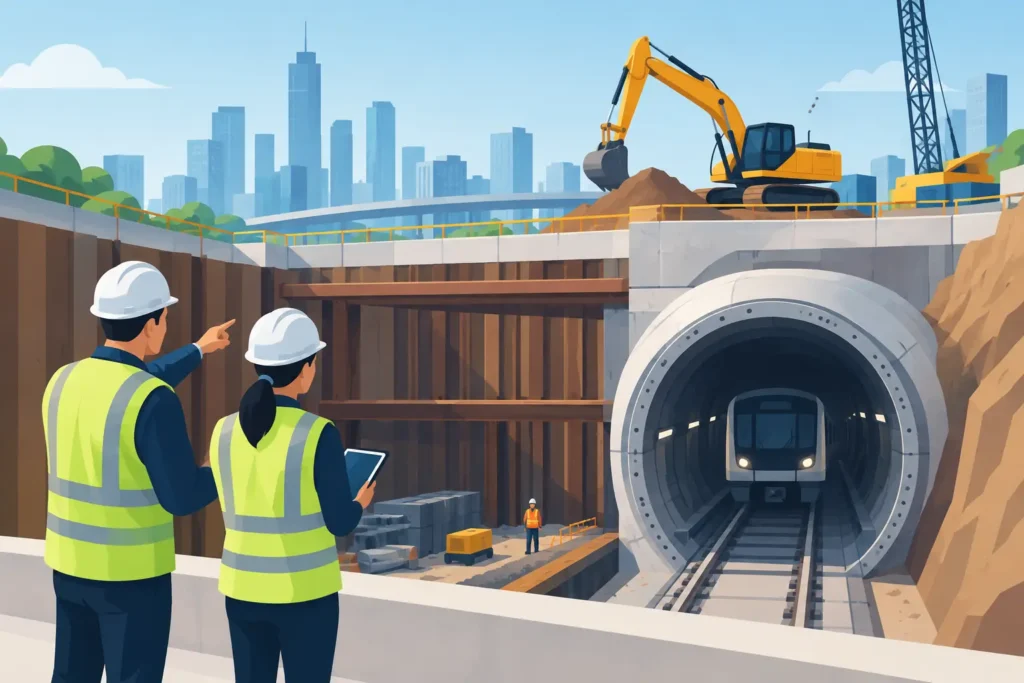
A metro box can look controlled on the programme drawing: retaining walls, staged excavation, struts or slabs, base slab and fit-out. In practice, metro excavation lessons learned usually concern the interfaces hidden behind that sequence – variable ground, groundwater, adjacent structures, utility corridors, traffic constraints and decisions made before movements become visible.
For underground works in dense urban settings, excavation is not merely an earthworks operation. It is a managed change in stress, groundwater conditions and structural response. The most useful lessons are therefore not generic calls for more data or more monitoring. They are about deciding what information is needed, assigning responsibility for interpretation, and retaining practical options when actual conditions differ from the design assumption.
Metro excavation lessons learned start with the ground model
A factual ground investigation report is essential, but it is not yet a working ground model. Boreholes, laboratory tests, probe results and historic records must be translated into an engineering view of likely soil and rock behaviour along the excavation and at each sensitive interface.
The distinction matters. A borehole may identify a clay layer, fractured rock or a permeable sand lens. The construction team needs to understand whether that feature can drive wall movement, basal instability, inflow, loss of fines, uneven support reaction or ground settlement at a particular stage. The model also needs to state its uncertainty clearly. False precision encourages poor decisions.
Urban metro projects commonly encounter ground that is both variable and partly modified by previous construction. Fill, old foundations, abandoned basements, timber piles, utility trenches and local grout zones can affect deformation patterns as much as the regional geology. Historic drawings are useful, but should be treated as evidence to test rather than confirmation of what is present.
The practical lesson is to update the ground model throughout construction. Instrument readings, excavation face mapping, spoil observations, drilling returns and water inflow records should feed back into the model. This does not mean redesigning the works each week. It means maintaining an agreed explanation for observed behaviour and checking whether the remaining construction sequence remains appropriate.
Design parameters need an observational context
Characteristic parameters are necessary for design, yet a single representative value cannot describe every metre of a station excavation. Sensitivity checks are therefore more valuable than a long table of parameters with many decimal places. Which assumptions control wall deflection? What is the consequence of a locally weaker layer? How would elevated pore pressure alter basal heave margins or anchor performance?
Where the consequences of unexpected behaviour are high, the observational method can provide a disciplined route forward. It requires defined predictions, measurable response quantities, action thresholds and pre-agreed interventions. Monitoring alone is not an observational method. It becomes one only when the project has decided what it will do if the measurements depart from expectations.
Support systems must be built as designed
Retaining walls and internal support are often designed as a system, but constructed as a series of activities by different parties. Wall continuity, guide wall quality, reinforcement placement, joints, strut preloads, connection details and excavation levels all affect performance. Small deviations can accumulate before the first major movement is registered.
Diaphragm walls and secant pile walls require particular attention to verticality and continuity. A local defect may not produce an immediate problem, but it can become significant when excavation exposes a permeable path or reduces passive resistance where it was assumed. In rock, the equivalent issue may be an unfavourable discontinuity set, overbreak or inadequate treatment of the contact between support and rock mass.
Temporary works deserve the same engineering discipline as permanent works. A prop removed early to improve access, a delayed slab pour, an unplanned excavation below a support level or an altered plant route may change load paths substantially. The design team should know about such changes before they are made, not after an inclinometer plot begins to steepen.
Constructability reviews are especially effective when they examine the actual sequence rather than the finished arrangement. Ask how each support is installed, loaded, inspected, protected from impact and eventually removed. The answer often exposes constraints that are invisible in a conventional drawing review.
Water is often the controlling mechanism
The most disruptive excavation events frequently involve water, even where the principal concern has been structural movement. Water can create uplift, soften or erode soil, transport fines through defects, reduce effective stress and complicate excavation at the formation level. It also has a direct effect on neighbouring assets when drawdown extends beyond the excavation.
The key distinction is between controlling inflow and controlling groundwater regime. Internal pumping may keep a work area dry while causing external drawdown and settlement. Cut-off walls may reduce flow but not eliminate it, particularly at joints, toe interfaces or through more permeable strata below the wall. Conversely, a local seepage event may be manageable without resorting to a large dewatering scheme that creates wider risks.
Piezometers should be located to answer specific questions: whether the cut-off is performing, whether pore pressures below the base remain within expectation, and whether off-site drawdown is occurring. Their value depends on reliable datum control, routine reading and a person who can distinguish a genuine trend from a damaged instrument or implausible datum.
Grouting can be an effective response, but it is not a universal repair. The choice between permeation, compaction, fracture or contact grouting depends on ground conditions, water pathways and the mechanism being addressed. Treatment verification must be defined before work starts. Otherwise, production records may show that grout was injected without demonstrating that permeability, voiding or stiffness changed sufficiently.
Monitoring must lead to decisions
Metro excavation monitoring is sometimes treated as a contractual deliverable rather than an engineering control. Data dashboards can make this worse: they present a large volume of readings without explaining the mechanisms behind them. A useful monitoring plan is selective, spatially coherent and tied to the construction sequence.
Wall inclinometers, settlement points, building levelling, strain gauges, load cells and piezometers each measure different aspects of behaviour. No individual instrument gives the full answer. A rising prop load may be acceptable if it matches the expected transfer of load, while the same reading combined with accelerating wall deflection and falling pore pressure may indicate a developing problem.
Trigger levels should have three characteristics. They should be linked to design assumptions or asset tolerance, adjusted for rate as well as magnitude, and connected to named actions. A single absolute limit can be misleading. Slow, stabilising movement may be less concerning than a smaller but accelerating movement after a change in excavation stage.
Daily interpretation is most valuable around transitions: first excavation below a support level, strut preloading, breakthrough into a new geological unit, changes to pumping, slab casting and removal of temporary support. These are the points where a comparison between predicted and measured response can materially improve the next decision.
Interfaces, not calculations, often determine the outcome
Most major metro excavations involve designers, contractors, specialist subcontractors, survey teams, utility owners, transport authorities and third-party building owners. Technical information is easily lost between these groups. The issue is rarely a lack of reports. It is the absence of a shared, current understanding of what has changed and who is authorised to respond.
An effective interface process records assumptions that matter in the field: permitted excavation levels, utility protection measures, access restrictions, hold points, monitoring triggers and contingency materials. It should also identify decisions that cannot wait for the next formal meeting. If a seepage path appears overnight, the site team needs a route to obtain engineering advice and authority to act.
This is where simple, transparent calculation tools have a role. Engineers need to check a revised stage, compare water-pressure assumptions, review a stability margin or communicate a sensitivity case without creating a fragmented chain of spreadsheets and screenshots. The tool does not replace engineering judgement, but it can make the judgement traceable and available to the people who need it.
Preserve contingency before it is needed
The least expensive intervention is often the one planned before excavation begins. Contingencies may include additional propping positions, grout ports, standby pumping capacity, temporary ballast, rapid access to drilling equipment, alternative excavation sequences or defined load restrictions near the wall. Not every project needs all of these. The appropriate measure depends on ground uncertainty, asset sensitivity and available space.
Contingency planning has a cost, and over-provision can become wasteful. However, the cost should be compared with the delay caused by designing, procuring and approving an intervention during an emerging event. On constrained metro sites, physical access and permissions can be harder to obtain than the equipment itself.
The most durable lesson is to treat excavation as a measured engineering process rather than a fixed production activity. When the ground model, support sequence, water control and monitoring interpretation remain connected, the team has time to make proportionate decisions. That time is the real safety margin. Build the habits and tools that preserve it before the first bucket reaches formation level.
