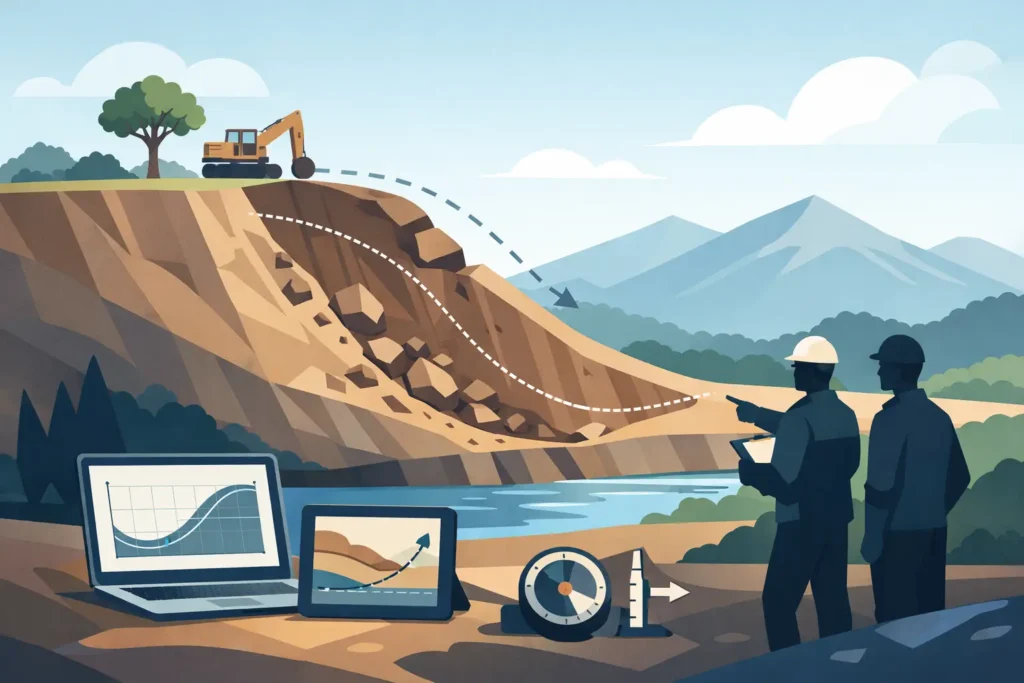
A slope has already moved. The scarp is visible, the geometry can be surveyed, pore pressure conditions may be partly known, and someone in the project meeting asks the obvious question: what is back analysis slope stability, and why does it matter here?
In geotechnical practice, back analysis is the process of working backwards from an observed slope failure, or from a slope that is known to be at limiting equilibrium, to estimate the material parameters or groundwater conditions that would make the calculated factor of safety consistent with what actually happened. Instead of starting with laboratory strengths and asking whether failure will occur, you start with the failure and ask what strengths, pore pressures, or loading assumptions best explain it.
That sounds simple, but the engineering value lies in the detail. Back analysis is not a mathematical trick. It is a disciplined way to reconcile field evidence, laboratory data, site investigation, and calculation method. Used properly, it helps engineers understand whether a failure was controlled by low effective shear strength, unfavourable pore pressure, geometry changes, weak interfaces, or a combination of these factors.
What is back analysis slope stability used for?
The most common use is after a failure or significant deformation event. A cut slope in clay may have slipped after excavation. An embankment may have shown progressive movement during construction. A natural slope may have failed after prolonged rainfall. In each case, the engineer needs more than a descriptive explanation. The project needs defensible parameters for remedial design, risk assessment, and checking nearby slopes under similar conditions.
Back analysis is also used where a slope has not fully failed but appears to be close to failure. If reliable field observations suggest a limiting condition, the engineer can analyse that state and infer a realistic mobilised strength. This can be useful in staged construction, old landslide reactivation, and temporary works where available test data are sparse or scattered.
There is, however, a trade-off. Back analysis gives insight into the conditions that existed at the time of movement. It does not automatically give a universal design parameter set for every future condition. A parameter inferred from one failure mechanism may not be transferable to another geometry, loading case, or drainage regime without judgement.
How back analysis works in slope stability
In practical terms, the engineer first defines the geometry of the failed or marginally stable slope as accurately as possible. That includes slope shape, stratigraphy, slip surface evidence if available, surcharge, excavation history, and groundwater conditions. The better the reconstruction, the more useful the back analysis will be.
The calculation model is then set up using an appropriate slope stability method. This may be a limit equilibrium analysis with circular or non-circular slip surfaces, depending on the ground conditions and expected mechanism. The engineer adjusts uncertain inputs, often shear strength parameters such as c’ and phi’, undrained shear strength, or pore pressure distribution, until the model produces a factor of safety close to 1.0 for the observed failure condition.
That last point is central. If a slope has genuinely failed, the back-calculated condition is usually associated with a factor of safety around unity. If the slope is judged to have been on the verge of failure rather than fully failed, a slightly different target may be appropriate. Engineering judgement is doing real work here.
What parameters are commonly back-calculated?
The answer depends on the type of slope and the quality of available evidence. In effective stress analyses, engineers often back-calculate friction angle, cohesion intercept, or both, although doing both at once can create non-unique solutions. In undrained analyses, the focus is often on the undrained shear strength profile.
Pore pressure is equally important. A slope may appear to require implausibly weak strength parameters if the groundwater model is too optimistic. In many real failures, the key uncertainty is not strength alone but the pore pressure regime at the time of failure. Perched water, delayed dissipation, artesian response, rainfall infiltration, or construction-induced changes in drainage can all control the result.
Some back analyses also consider external loading, tension cracks, seismic action, or interface strengths along weak layers. In rock slopes, the process may focus more on discontinuity properties and structural control than on soil-type strength parameters.
Why laboratory data alone are not enough
Laboratory testing remains essential, but anyone who has compared triaxial results with field performance knows the gap can be significant. Sample disturbance, scale effects, anisotropy, fissuring, strain localisation, and groundwater uncertainty can all make direct use of lab values problematic.
Back analysis helps bridge that gap by anchoring the calculation to observed behaviour. If the field evidence says a slope failed under a known geometry and loading history, and the laboratory strength appears too high to permit failure, the engineer has to ask why. Perhaps the sample quality was poor. Perhaps the critical layer was missed. Perhaps progressive failure reduced the mobilised strength below peak values. Perhaps pore pressures were underestimated.
This is where back analysis becomes more than a calibration exercise. It tests the coherence of the whole ground model.
The main limitation: non-uniqueness
A back analysis result can look precise while still being uncertain. That is one of the main reasons experienced engineers treat it carefully.
Different combinations of strength and pore pressure can produce a similar factor of safety. Different slip surface assumptions can also lead to different inferred parameters. If the actual failure surface is only partly known, or if the groundwater conditions were not monitored, there may be several plausible explanations for the same event.
For that reason, back analysis should not be treated as a single-button answer. It works best when constrained by independent information such as laboratory testing, inclinometer data, piezometer readings, mapped geology, and a credible construction timeline. The more field evidence you can bring into the model, the less room there is for misleading parameter combinations.
What is back analysis slope stability in day-to-day design work?
For practicing engineers, what is back analysis slope stability really about? It is about improving decisions when ground behaviour has already given you useful information, often expensive information.
A good back analysis can help determine whether remedial measures should focus on unloading, drainage, buttressing, reinforcement, or geometry change. It can also support more realistic parameter selection for adjacent slopes in similar materials. In infrastructure projects, that matters because remedial works are often time-critical and cost-sensitive. Overly conservative assumptions can produce heavy and expensive solutions. Overly optimistic assumptions can lead to repeat failures.
This is also where calculation software matters. The workflow needs to be clear enough that the engineer can test assumptions efficiently, review slip surfaces, compare parameter sets, and document why one interpretation is more credible than another. Straightforward input handling is not a cosmetic issue. It affects the quality and speed of technical judgement.
Choosing the right model for the problem
Not every slope problem should be back-analysed in the same way. A simple embankment failure in soft clay may be well suited to a conventional limit equilibrium model with carefully selected undrained strengths. A layered residual soil slope with transient seepage may require more care in defining pore pressures and failure mechanism. A rock slope controlled by discontinuities may need a structurally informed approach rather than a generic circular search.
The point is not to make the model more complicated than necessary. It is to match the model to the governing mechanism. In practice, the best back analyses are often the ones that are technically modest but well constrained by evidence.
For engineers working across desktop and site environments, there is an additional practical point. Observations made in the field lose value if they are not incorporated promptly into the analysis. Software workflows that move cleanly between macOS, iPhone, and iPad can help maintain that continuity, especially when geometry, groundwater observations, or staging assumptions need to be reviewed while decisions are still live.
When back analysis adds real value
Back analysis is most valuable when there is enough evidence to constrain the model and a clear decision depends on understanding the failure. It is less useful when the site investigation is too poor, the failure mechanism is unknown, and the analysis becomes an exercise in fitting assumptions to a desired outcome.
That distinction matters. In competent hands, back analysis can turn a failure into a source of engineering knowledge. In weak hands, it can become a post-rationalisation.
The practical lesson is straightforward. Use observed performance, but do not let the calculation outrun the evidence. If the inferred parameters make geological sense, align with field behaviour, and hold up against independent data, the result can be very powerful. If they only work inside one narrowly tuned model, caution is warranted.
A slope that has moved has already told you something important. Back analysis is the method that helps you listen carefully enough to use that information well.