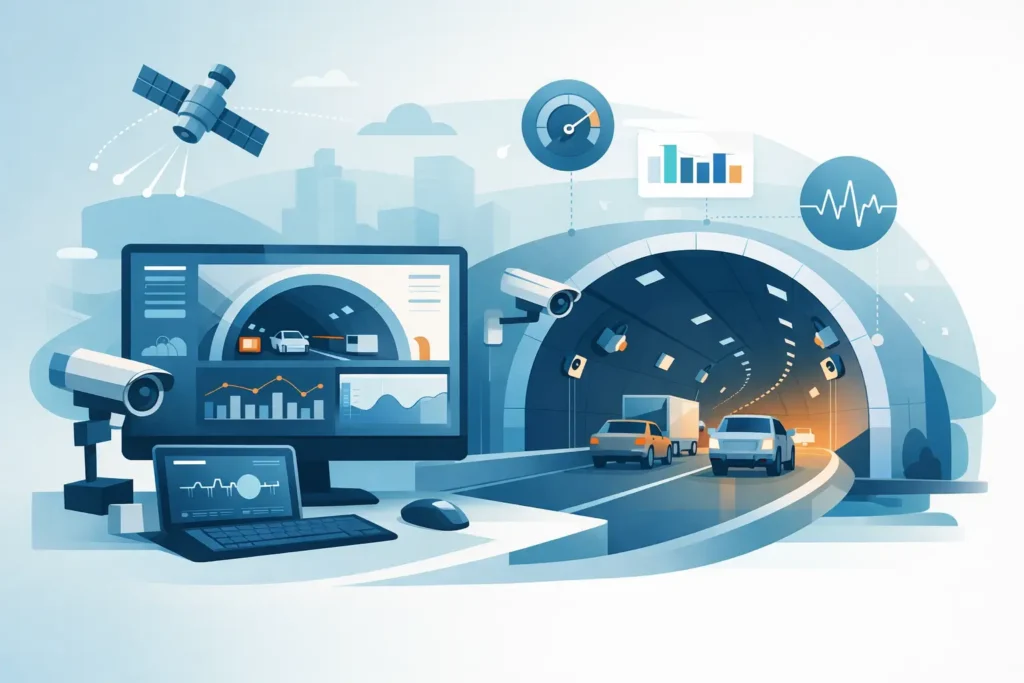
A tunnel is not controlled by a monitoring report produced after the shift has ended. Control depends on recognising a meaningful change early enough to check the excavation sequence, support installation, groundwater response or nearby asset condition. Tunnel monitoring software has value when it shortens that path from measurement to engineering judgement without obscuring the data behind polished graphics.
For tunnel engineers, instrumentation specialists and site teams, the question is therefore not simply whether data can be collected. The more useful question is whether the system makes each reading traceable, comparable with design assumptions and easy to discuss with the people responsible for the next construction decision.
What tunnel monitoring software should do
At its core, tunnel monitoring software should organise measurements from instruments and surveys into an engineering record that can be reviewed over time. Typical inputs include convergence readings, extensometer displacements, settlement points, inclinometers, piezometers, load cells, crack gauges and automatic total station observations. Depending on the project, vibration, face mapping, probe drilling and grouting records may also need to be considered alongside the monitoring data.
The software must retain the context of every value. A convergence result without a chainage, date, instrument identity, datum, monitoring section and excavation stage has limited value. The same applies to pore pressure data without a clear understanding of installation depth, reading method and the hydraulic conditions at the time.
A practical system brings this information together so that an engineer can inspect trends, compare locations and identify departures from expected behaviour. Graphs are useful, but they are not the analysis. The analysis lies in interpreting the rate of movement, the relationship between instruments and the construction activities that occurred before a change was recorded.
From readings to a defensible record
Monitoring often involves several organisations: the contractor, survey team, instrumentation supplier, designer, independent checker and client. Files may arrive in different formats and at different intervals. Manual spreadsheet handling can work for a small scheme, but it becomes difficult to audit when readings are frequent, instruments are replaced or alert levels change.
Good software creates a controlled record of imported or entered data, including corrections, missing readings and comments. It should distinguish an actual zero movement from an absent reading. It should also preserve the original observation where a processed value is used for reporting. These details matter when a trend is questioned weeks later during a technical meeting, claim review or incident investigation.
Designing tunnel monitoring software around decisions
The best setup begins with the decisions the monitoring programme must support. A sprayed concrete tunnel in competent rock requires a different emphasis from a shallow urban tunnel beneath sensitive buildings. In the first case, convergence, crown settlement, bolt loads and face conditions may dominate. In the second, surface settlement, building response, groundwater levels and track or utility movement can be equally important.
This does not mean every available instrument should be connected to one dashboard. Excess data can make an urgent signal harder to see. The monitoring plan should establish which parameters are safety-critical, which confirm the ground model and which provide useful background information. Software configuration should reflect that hierarchy.
Alert thresholds need similar care. A single displacement limit may be necessary for contractual reporting, but it rarely tells the full story. The rate of displacement, acceleration of movement, spatial extent and correlation with excavation advance are often more informative. A small but rapidly increasing movement may require attention before a larger, stable movement does.
Thresholds should therefore be linked to a defined response process: who receives the alert, who assesses data quality, who has authority to alter works, and what observations are required before work resumes. Software can distribute notifications and show status clearly. It cannot replace the project-specific engineering judgement behind those actions.
Construction stage is part of the data
A monitoring graph gains meaning when excavation rounds, support closure, invert installation, grouting, dewatering and other relevant events are visible against the same timeline. Without this information, a displacement curve can encourage false conclusions.
For example, an increase in convergence shortly after a face advance may be expected, particularly before ring closure. The same increase after closure, or following a change in groundwater regime, deserves a different assessment. Recording construction stages alongside measurements helps the team distinguish anticipated behaviour from a developing concern.
This is also where field usability matters. Site staff need straightforward input handling for observations, photographs and comments while working underground or moving between headings. If entering a construction event takes several screens and a strong network connection, it will be postponed or omitted. A simple, structured record is usually more valuable than a detailed process that nobody can maintain under production pressure.
Data quality before automation
Automatic data acquisition can provide frequent readings and reduce the burden of routine collection. It also creates a risk: an implausible value may be repeated, transmitted and plotted before anyone checks the instrument, communication path or reference condition.
Tunnel monitoring software should make data quality visible. Readings outside a credible range, sudden step changes, communication gaps and changes in instrument status should be identifiable without deleting the underlying observation. Engineers need to be able to mark a value as under review, explain why it was rejected or corrected, and retain an audit trail.
Reference stability deserves particular attention. Survey-based monitoring is only as reliable as its control network and reference points. Similarly, apparent pore pressure changes may arise from sensor drift, installation damage or a changed atmospheric compensation setting rather than a genuine hydraulic response. Software should support checks, but the monitoring procedure must define them.
There is a trade-off between automated exception rules and manual review. More rules can reduce routine checking, yet poorly chosen rules create alert fatigue. The appropriate balance depends on the consequence of missed movement, the quality of the instrumentation and the experience available to review results.
Clear outputs for different project roles
A monitoring coordinator may need an instrument health view and a list of overdue readings. A design engineer may need section plots, time series and comparison with predicted envelopes. A construction manager may need a concise status view showing where restrictions or additional checks apply. Each role needs the same underlying information, presented at a suitable level of detail.
Reports should be reproducible. A weekly report ought to state the reporting period, data cut-off, instruments included, alert criteria and any exclusions. If a chart is used to justify a construction decision, its source data and settings should be recoverable. This discipline is particularly useful when project personnel change or when the final as-built record is assembled.
Visual presentation still matters. A section view that shows convergence points, settlement markers, support class and relevant geology can reveal patterns that tables conceal. Colour-coded statuses can help a busy team prioritise review, provided that colour is never the only indicator. Labels, values and written status descriptions remain necessary for clear communication and accessible reporting.
Apple devices in tunnel monitoring workflows
Many monitoring activities occur away from the main office: at the portal, in a site cabin, during inspections or at technical meetings. For engineers using macOS, iPad and iPhone, continuity between devices can remove unnecessary transcription. A field note entered on an iPad should be available for review on a Mac without recreating it in a separate document.
That convenience must not compromise control of project data. Offline working, synchronisation status, permissions and backups require explicit consideration, especially where connectivity underground is unreliable. A mobile workflow is most effective when it supports defined tasks such as inspection records, photographs, manual readings and review of current trends, rather than attempting to place every administrative function on a phone.
Psicons AB approaches engineering software with this practical Apple-based workflow in mind: technically serious tools that remain clear enough to use in real project conditions.
Selecting a system for the project, not the sales demonstration
When assessing tunnel monitoring software, test it with representative project data rather than only prepared sample charts. Import readings with gaps and corrections. Set up monitoring sections with different instrument types. Check whether construction events can be recorded against trends. Produce a report that another engineer can reproduce. Review how an alert is logged, acknowledged and closed.
Also consider the expected life of the data. A short construction package may need a lean solution that supports disciplined reporting. A major underground project may require interfaces with survey systems, data loggers, common data environments and client reporting requirements. More integration can save effort, but it increases configuration, validation and maintenance demands.
The useful measure is not the number of features. It is whether the software helps the project team understand ground and structural response early, document its reasoning properly and act with proportionate confidence. When the next excavation round depends on that judgement, clarity is a technical requirement, not a cosmetic preference.