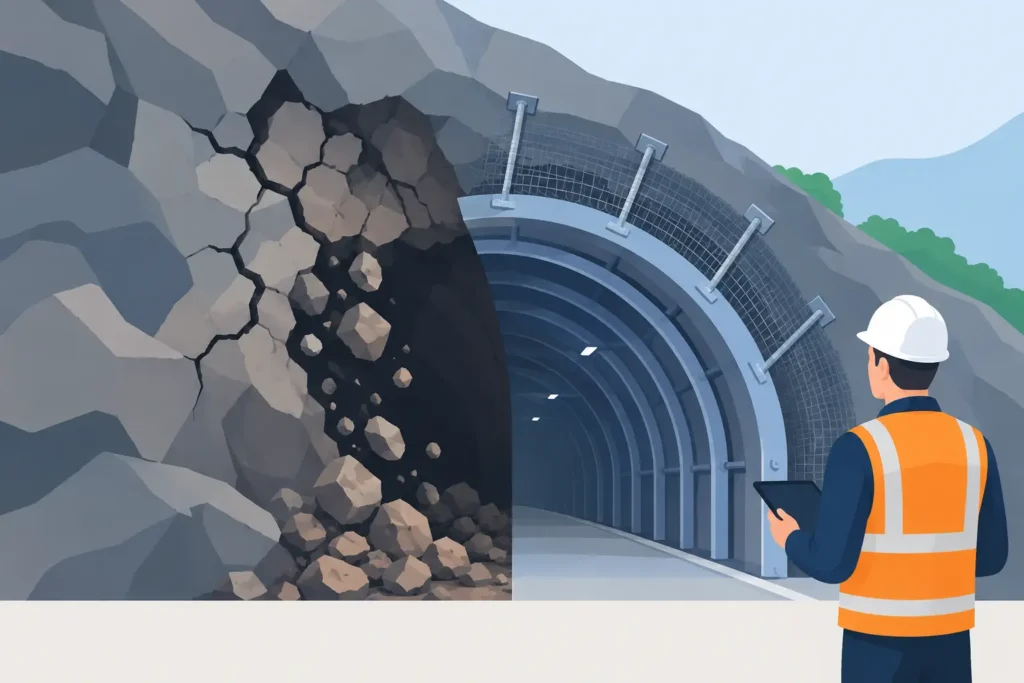
Tunnel face instability is rarely the result of one isolated error. It develops when the available ground strength, groundwater conditions and excavation support no longer provide sufficient resistance to the stresses acting ahead of the tunnel. For the designer and site team, the practical consequence can range from increased convergence and surface settlement to sudden loss of ground, equipment damage and a serious safety event.
The critical point is that face stability is not a fixed property of the ground. It changes with excavation sequence, advance length, support pressure, water conditions and the time allowed before the next support action. A calculation may demonstrate an acceptable safety margin for a stated set of assumptions, but that margin must remain meaningful during construction.
Why tunnel face instability develops
At the face, the three-dimensional confinement provided by the unexcavated ground is removed. The tunnel support system must replace enough of that confinement to prevent a failure mechanism from extending ahead of, above or around the excavation. The mechanism depends strongly on whether the ground behaves predominantly as drained frictional soil, undrained clay, weak rock, mixed face material or a fractured rock mass influenced by water.
In granular soils, instability commonly results from inadequate effective stress. If pore water pressure is high, the soil skeleton carries less load and its frictional resistance falls. The face may then loosen progressively, or a local inflow can develop into running ground. Fine sands and silts deserve particular attention because their response can be sensitive to small changes in hydraulic gradient, disturbance and support pressure.
In soft clays, short-term undrained strength is often central to the assessment. The face can deform plastically before an identifiable collapse surface develops. This does not make the situation benign. Progressive deformation may increase volume loss and settlement before the face reaches an obvious failure state. The advance rate, time between excavation and lining installation, and stress history of the clay can all affect the outcome.
Weak rock and mixed-ground conditions introduce another set of uncertainties. Block release, ravelling, sheared zones, weathered seams and abrupt changes in rock mass quality may govern local behaviour more than the average rock classification. A stable rock crown does not guarantee a stable invert or face. Where soil, weathered rock and competent rock occur together, support selection must reflect the least favourable credible condition rather than the most convenient geological description.
The role of groundwater and support pressure
Water is often the factor that changes a manageable risk into an unstable face. It reduces effective stress in soil, transports fine material, increases loads on temporary works and can create inflow paths through fractures or interfaces. The groundwater model therefore needs the same scrutiny as the geological model. A single piezometric level may be insufficient where confined aquifers, perched water or anisotropic permeability are possible.
For pressurised shield tunnelling, face pressure must balance the earth and water pressures without causing excessive uplift or heave. The target pressure is not simply a theoretical value. It needs to account for depth, ground stratigraphy, groundwater distribution, pressure losses, operational fluctuations and the consequences of stoppages. Slurry and earth pressure balance machines achieve control differently, but both depend on reliable pressure measurement and disciplined operation.
For conventional excavation methods, control may involve staged excavation, face bolting, spiling, pipe umbrellas, forepoling, shotcrete, lattice girders or a combination of measures. Grouting may be required to reduce permeability, improve local ground conditions or limit inflow. Each measure has limitations. Pre-grouting can be highly effective where fractures or permeable zones are accessible, but its performance depends on grout spread, ground structure, verification and the interaction with later excavation.
Dewatering also requires caution. Lowering groundwater pressure may improve local face conditions, yet it can increase effective stress beyond the tunnel and induce settlement in compressible soils. The preferred approach depends on the project setting, the sensitivity of nearby assets and whether water exclusion can be achieved instead.
Assessing tunnel face instability before excavation
A useful assessment begins with a ground model that describes variation, not only average parameters. Borehole records, probe drilling, face mapping, geophysics and groundwater observations should be interpreted together. The question is not merely whether a soil layer or rock type is present, but how it is likely to behave at the excavation scale.
The calculation method should suit both the ground and the construction method. Limit equilibrium approaches can give transparent estimates of face stability and support demand, particularly for defined soil conditions. Numerical modelling can represent staged construction, complex geometry, structural interfaces and non-uniform loading. Neither approach removes the need for engineering judgement. Input selection, drainage assumptions and the adopted failure mechanism often influence the result more than the apparent sophistication of the model.
Sensitivity analysis is especially valuable. Rather than relying on one parameter set, assess credible low strength, high water pressure and reduced support cases. This reveals whether the design has a practical operating margin or whether small deviations could trigger unacceptable deformation. It also helps the construction team understand which measurements matter most.
Parameters that need careful treatment
Strength parameters should be selected with the failure mode and drainage condition in mind. Drained friction angle and effective cohesion may be appropriate for long-term granular behaviour, while undrained shear strength may control short-term clay response. For rock, intact strength alone is rarely enough. Joint orientation, spacing, persistence, infilling, weathering and water pressure can govern the available support.
The assumed unsupported span and advance length require equal care. A design that is stable for a short round may not remain stable if logistics, equipment problems or poor ground conditions extend the exposure time. Temporary support is part of the structural system, not an afterthought.
Construction controls that protect the face
The most effective controls connect design assumptions to field operation. Advance rounds, excavation sequence, support class, allowable stand-up time and probe drilling requirements should be clear enough to use at the heading. If the specified response cannot be applied in the available working space or within the planned cycle, it is not yet a workable control.
Monitoring should provide early evidence of changing behaviour. Face observations, convergence measurements, crown settlement, surface levelling, piezometers and machine data each show different parts of the picture. Trends are generally more useful than isolated readings. A gradually accelerating convergence trend may warrant intervention before any formal trigger value is exceeded.
Four warning signs deserve immediate technical review:
- increasing water inflow or turbidity, particularly where fines are being carried;
- loosening, ravelling or unexpected deformation at the face and crown;
- convergence or settlement rates that accelerate between readings; and
- a mismatch between predicted and encountered geology, including weak seams or open fractures.
The response should be proportionate to the observed mechanism. It may involve reducing the advance length, increasing face support pressure, installing additional fore-support, modifying the excavation sequence, revising grouting or temporarily stopping excavation. Continuing with the original method while waiting for certainty is seldom a sound risk-management strategy when ground loss is developing.
Making calculations useful at the heading
A face stability calculation has value when it can be checked, updated and communicated without friction. Clear input handling makes it easier to test alternative groundwater levels, support pressures, excavation dimensions and strength assumptions as new information arrives. Graphical outputs can help a site team see the implications of a changed parameter, while concise text outputs preserve the assumptions and results for design records.
This is where purpose-built engineering software is useful. For engineers working across office and site environments, the ability to review a calculation on macOS, iPad or iPhone can reduce delays between observation and technical decision. Psicons AB focuses on straightforward, specialist tools that support this type of practical engineering workflow, while leaving responsibility for ground interpretation and design judgement with the engineer.
Tunnel face instability is best managed as a live engineering problem. A well-chosen support system, realistic groundwater model and transparent calculation create the basis for control, but observations at the face determine whether the assumptions remain valid. The strongest projects make that feedback loop fast enough to act before a small deviation becomes ground loss.