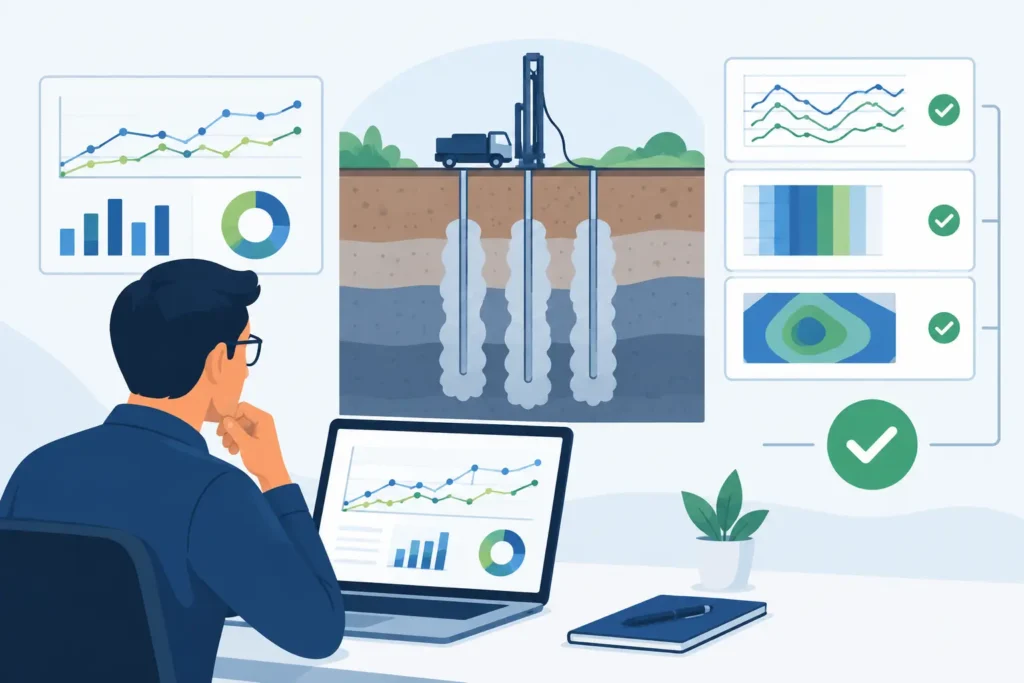
A grout shift can produce thousands of readings yet still leave the engineer unable to justify a decision. To validate grouting data is not simply to check that every field in a log has a value. It is to establish whether recorded pressure, flow, volume and time describe the actual treatment of the ground well enough to support design changes, acceptance decisions or further investigation.
For tunnel, dam, foundation and underground works, poor data validation has familiar consequences. Apparent high takes may be caused by an incorrect stage length, a delayed timestamp or a meter reset. Low pressure may reflect a deliberately selected limit, leakage in the system, or a pressure gauge located at the pump rather than at the grout hole. The numbers must be credible individually and coherent as a set.
Validation is different from acceptance
A grout record can be valid without demonstrating that the specified grouting objective has been achieved. Equally, an apparently favourable result cannot be accepted if the underlying measurements are uncertain. Validation asks whether the data are traceable, internally consistent and representative of the operation. Acceptance asks whether the observed behaviour meets the design intent and defined criteria.
Keeping these questions separate prevents a common error: treating a completed log as proof of adequate sealing or improvement. A complete record may prove that a stage was grouted according to a stated procedure. It does not by itself prove that the grout reached the intended fractures, reduced permeability, or improved the target ground volume.
The required level of validation depends on the decision at stake. Daily production control may tolerate a prompt review of key trends. Decisions on curtain completion, residual water ingress, contractual quantities or unexpected geological conditions need a more disciplined audit trail.
Start with the record chain
Reliable validation begins before pressure and volume are interpreted. Confirm that each stage can be identified without ambiguity: hole ID, chainage or coordinates, inclination, drilled depth, stage interval, date, shift, grout mix and operative record should refer to the same work item.
Depth errors deserve particular attention. A stage labelled 18 to 23 m may be measured as borehole depth, true vertical depth, distance from collar or distance from a reference point in a probe hole. These conventions are not interchangeable, especially in fan patterns and inclined holes. The log should state the convention and show the intended relation to geological sections, probe-hole observations and adjacent grout holes.
Time is equally useful. Check that the start and finish times are plausible for the recorded volume and flow rate. A stage reporting 800 litres over two minutes at a stated delivery rate of 40 litres per minute is not necessarily wrong, but it requires explanation. It may indicate parallel pumping, a manually entered time, a meter total carried forward from a previous stage, or a unit conversion error.
The same discipline applies to grout recipes. Water-cement ratio, admixture dosage, density and batch number need enough detail to show what was pumped. If mix properties changed during a stage, that change should be visible. Comparing volumes from materially different mixes as though they were identical can obscure the ground response.
Check what the instruments actually measured
Pressure, flow and volume are often presented as direct facts. In practice, each is a measurement produced by an instrument in a particular position and operating condition.
For pressure, establish where the transducer or gauge is located. Pump pressure includes losses in hoses, manifolds, valves and packers. It may also include elevation effects. Borehole pressure at the treatment zone can be materially lower or higher than the displayed value, depending on the arrangement. For detailed interpretation, the pressure reference should be defined and any correction method documented.
Calibration status matters, but calibration certificates alone are not enough. A blocked pressure line, an air pocket, a damaged sensor cable or a poorly seated packer can produce misleading values during the shift. Look for smooth, physically credible pressure traces and compare them with operator notes. A sudden pressure collapse accompanied by rising flow may indicate fracture opening or leakage. The same pattern with no change in flow may indicate a measurement problem.
Flow meters and volume counters should also be reconciled with batch records where possible. A small difference is expected because of line filling, wash-out, priming and residual grout. A large unexplained difference is a warning that the recorded take may not belong entirely to the treated stage.
How to validate grouting data through reconciliation
The most useful checks compare related data rather than reading each column in isolation. Volume should reconcile with pumped time and average flow. Cumulative volume should match the sum of increments. Pump pressure should be considered alongside pressure limit, packer setting and the expected depth. Drilled and grouted intervals should correspond with the planned hole geometry.
Plotting pressure, flow and cumulative volume against time is often more informative than reviewing a final stage total. A genuine grout take usually has a recognisable sequence: connection and initial filling, a response as the system stabilises, then a change in flow or pressure as the stage approaches refusal, reaches a pressure limit or communicates with open ground. The precise form depends on the grout, geology and procedure, but the trace should tell a credible operational story.
Consider a stage with a large final volume at modest pressure. That result may be entirely reasonable in open joints, karstic ground or coarse granular material. It becomes questionable if surrounding holes, probe results and geological mapping indicate tight, competent rock. Conversely, a rapid rise to a pressure limit at very low volume can represent tight ground, a short-circuited packer, blocked outlets or premature set. Validation means identifying which explanation is supported by the available evidence.
Automated systems make it easier to collect data at short intervals, but they do not remove the need for review. They can repeat a wrong hole identifier, preserve an incorrect sensor offset or generate smooth charts from a disconnected pressure line. Automated capture improves traceability when configured well; it does not replace engineering judgement.
Validate grouting data against ground response
Grouting is an interaction with a geological system, not a pumping exercise. Data should therefore be reviewed in relation to core logging, fracture frequency, permeability tests, water losses, excavation observations and the pattern of previous grout holes.
Spatial comparison is particularly valuable. A high take in one hole may be expected where a mapped shear zone crosses the curtain. Repeated high takes along a line may indicate a connected feature, inadequate overlap, an unsuitable grout sequence or a need to reconsider the hole pattern. Isolated high volumes near the collar can point towards surface leakage or shallow voids rather than deep treatment.
Stage length affects interpretation. A five-metre stage can conceal a narrow but significant conductive fracture that would be clear in a shorter stage. Shorter stages provide better resolution but increase drilling, packer operations and programme time. The appropriate choice depends on fracture spacing, target permeability, risk level and the purpose of the grout curtain. Validation should record this limitation rather than imply a precision the stage geometry cannot provide.
Water pressure conditions also matter. If grouting occurs against significant groundwater pressure, the effective pressure driving grout into fractures is not the same as the indicated pump pressure. The procedure should state how pressure limits relate to groundwater conditions and rock cover. Without that context, pressure records can be compared incorrectly between locations or shifts.
Treat anomalies as engineering questions
Data validation is most valuable when it identifies exceptions early enough to act. Useful exception checks include duplicate stage IDs, overlapping depth intervals, zero-duration stages with recorded volume, pressure values above the permitted limit, abrupt counter resets and volumes that exceed the available batch quantity. These checks should flag records for review, not automatically label them failures.
The review needs a short explanation from the people closest to the work. Was there a hose change? Was grout deliberately returned and recirculated? Did the packer move? Was a geological feature encountered while drilling? A concise, contemporaneous note can turn an apparent inconsistency into understandable evidence. A note written days later, after memories and shift details have blurred, is less useful.
Where data cannot be verified, retain the record but mark its limitation clearly. Deleting inconvenient values damages traceability and can create a false impression of uniform ground conditions. The better approach is to distinguish between measured, corrected, estimated and unreliable values in the project dataset.
Build validation into the workflow
The best time to find a wrong hole ID or implausible flow rate is while the crew and equipment are still available. Field forms and digital input screens should make the critical fields straightforward to complete, use consistent units and prevent impossible combinations where practical. They should also allow engineers to review plots and stage histories without moving data repeatedly between disconnected systems.
For teams working between site, office and travel, a consistent workflow across Mac, iPad and iPhone can reduce transcription and version-control errors. The goal is not more administration. It is a clear path from measured data to a reviewed engineering record, with assumptions visible at each step.
A well-validated grout dataset gives the project team something more useful than a stack of completed logs: evidence that can be questioned, compared and used with confidence. When an unusual stage occurs, let the data prompt a focused engineering discussion while the ground conditions, equipment arrangement and operational details are still known.