
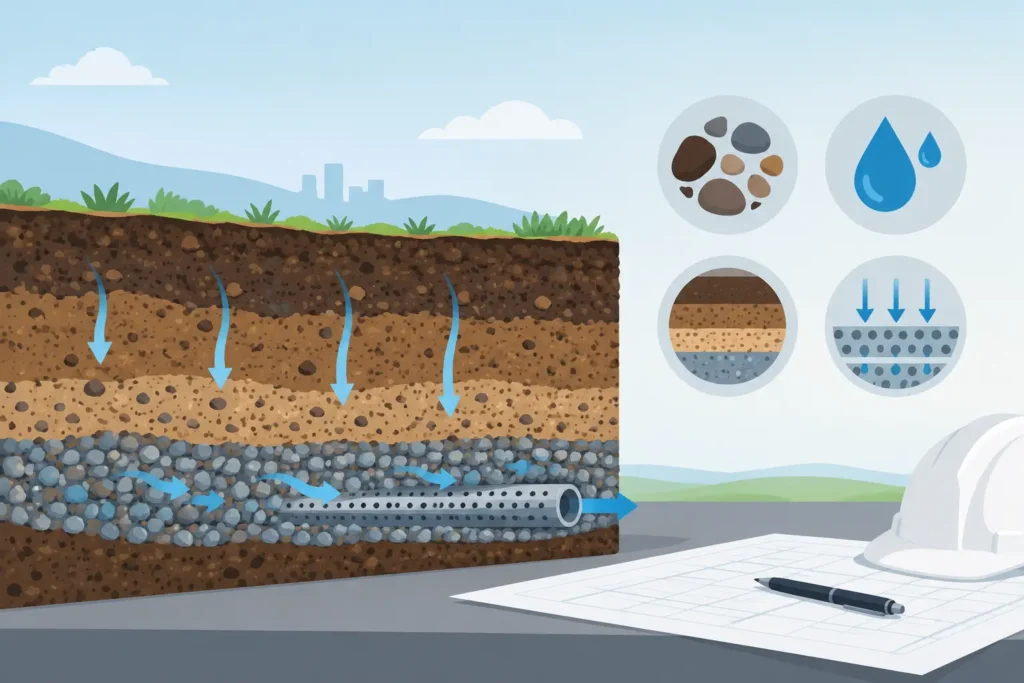
A drained analysis can look deceptively straightforward: assign effective cohesion, friction angle and stiffness, then run the calculation. In practice, drained soil parameters are only dependable when they represent the soil fabric, stress history, drainage path and deformation range relevant to the engineering problem. A neat set of laboratory results is not, by itself, a design model.
For foundations, slopes, retaining structures, excavations and tunnels, the question is not simply which parameter is available. It is whether the selected value reflects long-term pore pressure dissipation and the stress path that the ground will actually follow. That distinction is central to defensible geotechnical design.
What drained conditions mean in design
A drained condition allows excess pore water pressures generated by loading to dissipate sufficiently during the event or design stage being assessed. The soil response is therefore described in terms of effective stress. This is commonly appropriate for long-term stability of slopes and retaining walls, slow construction in permeable soils, and serviceability assessments where consolidation has substantially occurred.
It is not synonymous with dry soil. A saturated clay may be analysed under drained conditions if the loading duration is long enough relative to its consolidation behaviour. Conversely, a sand can develop significant transient pore pressures during rapid loading, despite its generally high permeability. Drainage is a time-dependent boundary-condition question, not a material label.
For effective-stress shear strength, the familiar Mohr-Coulomb form is:
(tau_f = c’ + sigma’_n tan phi’)
where (c’) is effective cohesion, (sigma’_n) is effective normal stress and (phi’) is the effective angle of shearing resistance. The equation is useful, but its simplicity can obscure the amount of engineering judgement behind each input.
The drained soil parameters that usually control results
Effective friction angle and cohesion
For normally consolidated clays and many uncemented granular soils, the effective cohesion intercept may be zero or very small in a long-term interpretation. Assigning cohesion merely because a regression line produces a positive intercept can overstate stability, particularly when extrapolated outside the test stress range.
The friction angle should reflect density or consistency, mineralogy, particle shape, grading and stress level. A dense, angular crushed rockfill may display a markedly different response from a rounded glacial sand at the same relative density. For clays, the critical-state or constant-volume friction angle offers a useful reference, while peak strength may be appropriate only where the expected strain level, drainage conditions and fabric justify it.
A single value of (phi’) is often necessary for routine limit-equilibrium calculations. It should nevertheless be selected with an awareness of whether it represents peak, critical-state or residual behaviour. This choice is particularly consequential in slopes with pre-existing shear surfaces, fissured clay, or material that may experience large displacement.
Dilation angle
Dilation describes the volume increase that can accompany shearing of dense sands, overconsolidated clays and some rockfills. It affects calculated earth pressures, wall movements and numerical predictions of shear resistance. Treating dilation as equal to the friction angle is usually unjustified.
Peak friction in dense granular material commonly includes a dilatancy component that reduces as confinement increases. A design model that applies high dilation at depth can produce unrealistic movements and overly favourable resistance. If the calculation concerns large strains or a persistent shear zone, a lower dilation angle, often tending towards zero, is generally more representative.
Stiffness parameters
Strength determines whether a limiting state is reached; stiffness determines how the structure and ground move before that point. This is why drained settlement and excavation analyses cannot be supported by (c’) and (phi’) alone.
Depending on the model and purpose of the analysis, relevant inputs may include oedometric modulus, constrained modulus, secant Young’s modulus, unloading-reloading modulus and shear modulus. These are not interchangeable. An oedometer modulus relates to one-dimensional compression, while a triaxial secant modulus depends on confining stress, stress path and strain level.
Soil stiffness is also non-linear. Small-strain stiffness measured by seismic or bender-element methods can be orders of magnitude greater than the stiffness mobilised near failure. Using a small-strain value for an excavation movement calculation will predict a ground response that is too stiff. Using a failure-level stiffness for all serviceability stages may predict excessive deformation. The appropriate value depends on what the model is intended to reproduce.
Stress history and in-situ state
Overconsolidation ratio, preconsolidation stress and the coefficient of earth pressure at rest, (K_0), strongly influence drained behaviour. They help define the initial effective stress state before construction begins. An incorrect initialisation can distort calculated settlements, lateral deformations and support loads even when the strength parameters are reasonable.
For soft clay, a modest change in assumed preconsolidation pressure can alter both settlement magnitude and the transition from stiff to more compressible response. For heavily overconsolidated clay, fissuring and stress relief during sampling may make laboratory stiffness less representative of field behaviour. The design should therefore reconcile test data with geological history, in-situ measurements and observed performance of comparable ground.
Selecting values from investigation data
Laboratory drained triaxial tests provide direct information on effective-stress strength and volume change, provided specimens are of suitable quality and the test programme covers relevant stresses. Consolidated drained tests can be time-consuming in low-permeability soils. Consolidated undrained triaxial tests with pore pressure measurement are often used to derive effective-stress paths more efficiently, but their interpretation still requires care.
Direct shear tests can be highly valuable for interfaces, sands, residual strength and soils with a known shear-plane orientation. Their imposed failure plane is also a limitation. It may not represent the critical mechanism in an intact clay specimen or a complex natural deposit.
Field tests complement laboratory work rather than replace it. CPT data can support estimates of density, state parameter, friction angle and stiffness in sands. Pressuremeter and dilatometer testing can provide useful deformation parameters. Vane tests, piezocone dissipation data and high-quality sampling are particularly relevant in soft clay. No correlation should be adopted as a universal truth: local geology, calibration experience and data quality matter.
A practical parameter-selection process should first define the design situation and the expected drainage regime. It should then identify the relevant stress range, strain range and failure mechanism before selecting characteristic values from compatible evidence. This sequence avoids a common error: choosing a familiar parameter first and finding a use for it afterwards.
Characteristic values are not average values
A characteristic drained parameter is not simply the mean of test results, nor automatically the lowest measured result. It is a cautious value selected with regard to the variability of the ground, the volume of soil governing the limit state, the quality and quantity of evidence, and the consequences of an unfavourable interpretation.
Spatial variability deserves particular attention in layered or glacial deposits. A thin seam of weaker clay, a silt lens that controls drainage, or a polished discontinuity in a slope can govern performance while being poorly represented in an averaged profile. Separating geotechnical units on geological grounds is often more useful than applying a statistical treatment to a mixed dataset.
Design standards may then require partial factors or model factors. These should be applied in the prescribed design framework, not compensated for by introducing hidden conservatism into every input. Transparent parameter selection makes design review easier and helps identify where additional investigation would genuinely reduce uncertainty.
Checking the model against the engineering problem
A drained analysis should be checked from more than one direction. Does the adopted friction angle agree with observed density, grading and test behaviour? Does the stiffness predict credible settlement or wall movement? Are initial pore pressures and groundwater levels consistent with monitoring data and seasonal conditions? Is long-term drainage actually plausible through the strata and boundary conditions?
Sensitivity analysis is especially useful where results are governed by a small number of uncertain inputs. Varying (phi’), stiffness and groundwater assumptions separately reveals whether further testing should focus on strength, deformation or hydraulic conditions. It also prevents a polished output plot from being mistaken for certainty.
For numerical models, input handling should make these checks easy to follow in detail. Clear separation of drained strength, stiffness, permeability and initial stress inputs reduces the risk of mixing parameter sets from different design stages. This is one reason specialised, straightforward calculation tools are preferable to a generic workflow that hides assumptions behind default material models.
Psicons AB develops engineering software with this practical traceability in mind: calculation inputs and outputs should support professional judgement, not substitute for it.
The most useful drained parameter set is therefore not the most elaborate one. It is the set that is demonstrably compatible with the ground, the construction sequence and the decision being made – and that can still be explained clearly when the design is reviewed years later.
