
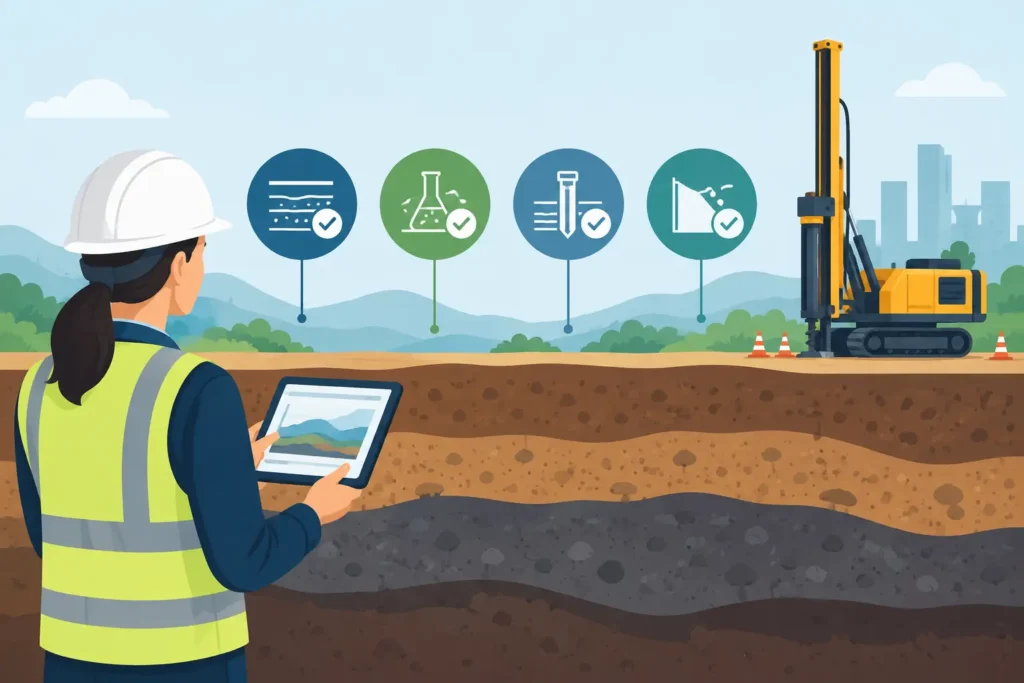
A calculation can converge cleanly and still be unsuitable for the ground beneath a project. That is why geotechnical validation checks should be treated as part of engineering judgement, not as an administrative step completed after the analysis is finished. They test whether the model represents the problem well enough for the decision being made.
For foundations, slopes, excavations, tunnels and grouting works, uncertainty is unavoidable. The practical objective is not to remove it with more decimal places. It is to identify the uncertainties that control safety, construction method, cost or programme, then show that the chosen design remains credible when those uncertainties are considered.
What geotechnical validation checks are intended to prove
Validation asks whether an analysis is fit for its intended purpose. Verification is different: it asks whether the equations, numerical implementation and calculation process have been applied correctly. Both are necessary, but a verified calculation may still be based on an unrealistic ground model, inappropriate drainage condition or poorly defined load case.
A useful validation process connects four things: the site evidence, the conceptual ground model, the selected analysis method and the anticipated field behaviour. If any one of these is weak, the output deserves caution regardless of how polished the report or graphical result appears.
The depth of checking should be proportionate. A preliminary appraisal for route selection does not require the same level of model refinement as a deep excavation beside sensitive assets. Equally, a simple problem should not be made obscure by a complex numerical model whose assumptions cannot be inspected or defended.
Start with the engineering question
Before reviewing parameters or plots, state what the calculation needs to answer. Is the question whether a cut slope has adequate stability during a short construction stage? Is it expected settlement of a structure? Is the issue water inflow and grout take around a tunnel? The answer determines which mechanisms, parameters and outcomes need the closest attention.
This step prevents a common failure mode: producing a technically elaborate analysis that answers a different question from the one faced by the designer or contractor. For example, a long-term drained slope analysis does not establish safety during rapid excavation where excess pore pressure may govern. A settlement model may be of limited value if the immediate concern is basal heave.
The required decision should also establish acceptance criteria early. These may include a target factor of safety, deformation limits, allowable inflow, support capacity or observational trigger values. Criteria should reflect project requirements and applicable standards, while recognising that a single calculated value is rarely the whole basis for acceptance.
Check the ground model before checking the numbers
The ground model is usually the most influential element of a geotechnical calculation. Validation begins with traceability from borehole records, samples, in-situ testing, mapping, groundwater observations and construction history to the simplified strata used in the analysis.
Ask whether the model captures the features that matter at the scale of the problem. A thin weak seam may be irrelevant below a shallow foundation yet control a potential slip surface in a cutting. For tunnel or rock excavation work, the orientation, spacing and persistence of discontinuities can matter more than an average rock mass classification. In urban ground, old excavations, fill boundaries, buried structures and poorly documented drainage routes may be decisive.
Groundwater requires particular discipline. A measured water level is not automatically a representative pore pressure distribution. Seasonal variation, perched water, recharge, pumping, tidal influence, drainage layers and excavation-induced drawdown can all change the condition. Where a design outcome is sensitive to pore pressure, it is sensible to check more than one credible water scenario rather than rely on a single assumed phreatic line.
Validate parameters against evidence and behaviour
Parameter selection should be transparent enough that another engineer can see why a value was chosen. This does not mean every value must come directly from one test result. It means the relationship between test data, correlations, geological understanding, design situation and selected characteristic or representative value must be clear.
Ranges are generally more informative than false precision. If undrained shear strength varies substantially with depth, treating it as one constant may be acceptable for screening but not necessarily for final design. If interface friction, stiffness degradation or hydraulic conductivity is uncertain, the analysis should demonstrate the consequence of that uncertainty.
Back-analysis of nearby works can provide valuable evidence when the geometry, ground conditions and construction sequence are comparable. It must not be transplanted without judgement. A measured settlement response from one site can be misleading where stress history, groundwater conditions or foundation arrangement differ.
A practical parameter review considers whether values are physically compatible. A high friction angle combined with very low dilation, an unusually stiff clay layer adjacent to soft deposits, or a permeability value inconsistent with observed inflow should prompt further investigation. The objective is not to force values into expected ranges, but to understand apparent inconsistencies.
Test the calculation method and model boundaries
Every method contains assumptions. Limit equilibrium slope analysis requires judgement about slip geometry, interslice forces and pore pressures. Finite element analysis requires appropriate constitutive models, mesh density, boundary location, initial stress conditions and staged construction. Analytical methods may be entirely suitable, provided their limits are recognised.
A reliable check is to compare the primary calculation with an independent estimate. This might be a hand calculation, an alternative method, a simplified equilibrium model or an order-of-magnitude assessment based on observed behaviour. Exact agreement is not required. Significant disagreement requires an explanation before the preferred result is used for design.
Boundary conditions deserve explicit attention. A model that places lateral boundaries too close to an excavation can artificially restrain deformation. A tunnel analysis that omits a realistic installation sequence may overstate support mobilisation. For seepage and grouting assessments, assumed hydraulic boundaries can dominate predicted flow paths and pressures.
Software improves repeatability, but it does not remove the need to inspect inputs. Units, sign conventions, layer order, groundwater levels, coordinate systems and load combinations should be reviewed systematically. Straightforward input handling is valuable because it makes these checks easier, especially when a model is reviewed away from the main desk.
Use sensitivity checks to find what actually controls risk
Sensitivity analysis is one of the most effective geotechnical validation checks because it shows whether a conclusion is stable or conditional. Vary the parameters, water conditions, geometry or construction stages that are both uncertain and influential. Then assess whether the design remains acceptable, or whether a modest change reverses the decision.
There is no benefit in varying every input arbitrarily. Focus on plausible ranges supported by site evidence and engineering judgement. A sensitivity case is useful when it represents a condition that could reasonably occur during the life of the works.
Where results are highly sensitive, the response may be additional investigation, a revised design, observational monitoring, temporary works controls or a more conservative construction sequence. It may also be acceptable to proceed if the uncertainty is explicitly managed. What matters is that the mitigation matches the controlling uncertainty.
Compare predictions with field observations
Validation does not end when construction starts. Monitoring turns assumptions into evidence. Inclinometer movements, settlement points, piezometers, convergence readings, face mapping, probe drilling results and grout records can confirm whether the ground is behaving as expected.
This is especially relevant for staged excavations, tunnelling and grouting, where construction changes the stress and groundwater regime. Observational data should be reviewed against predicted ranges, not only against a single calculated curve. A discrepancy does not automatically mean failure, but it should trigger a technical review of the model, parameters and next construction stage.
Monitoring is most useful when response actions are agreed beforehand. Define what will be measured, how often, what trend is concerning and who has authority to pause, alter or continue the works. Collecting data without a decision framework can create reassurance without control.
Make the checking process reviewable
A good calculation file allows an independent reviewer to follow the chain from evidence to decision. It should record the ground model, source data, selected parameters, design situations, assumptions, method limitations, sensitivity cases and interpretation of results. Graphical outputs are useful for exposing implausible failure mechanisms, stress distributions and water conditions, while concise text records the reasoning that graphics cannot show.
For engineers working between office and site, continuity matters. The ability to inspect a calculation, adjust a documented scenario and review outputs on macOS, iPad or iPhone can support timely decisions. However, portability should not weaken model control. Version identification, input provenance and formal review remain essential where a change affects design responsibility.
Psicons AB develops engineering software around this practical need: technical calculations should be simple to operate, clear to inspect and sufficiently transparent for professional judgement.
The strongest validation check is often a direct question: if this result were wrong, what assumption would most likely have caused it? Pursuing that question before work reaches site is usually more valuable than producing one more precise-looking number.
