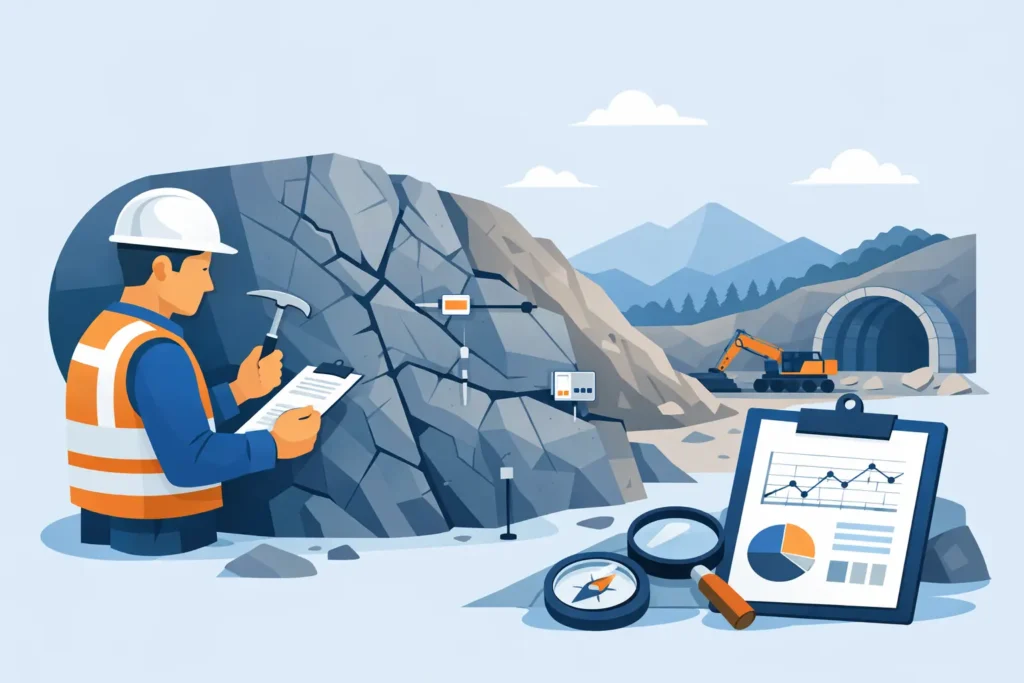
A tunnel face that looks competent in the morning can behave very differently by the afternoon once blasting, groundwater inflow or stress relief starts to act. That is why knowing how to assess rock mass is not a paperwork exercise. It is a design task, a construction task and, quite often, a risk management task carried out under incomplete information.
For practising engineers, the difficulty is rarely a lack of methods. The difficulty is deciding which observations matter, how much confidence to place in them, and how to move from description to usable design parameters without hiding uncertainty behind a classification number. Good rock mass assessment is structured, but it is never automatic.
What rock mass assessment is really trying to answer
At a practical level, rock mass assessment asks a short set of engineering questions. What is the intact rock like? How is it broken up by discontinuities? How will water, stress conditions and excavation method affect behaviour? And what does all that mean for deformation, stability, support demand, permeability or grout take?
That distinction matters because rock material and rock mass are not the same thing. A strong intact specimen in the laboratory can still belong to a poor rock mass if it is heavily fractured, weathered, clay-filled or unfavourably jointed. Equally, a modest intact strength may perform adequately where discontinuities are sparse, tight and well interlocked.
In other words, the task is not just to describe the rock. It is to describe the structure in which the rock exists.
How to assess rock mass in a workable sequence
The most reliable approach starts with observations and only then moves towards classification and design interpretation. Engineers sometimes reverse that order and try to fit the site into RMR, Q or GSI too early. That usually produces tidy numbers but weak understanding.
Start with geological and structural context
Before any formal logging, establish the geological model. Identify lithology, stratigraphy where relevant, degree of weathering, alteration and major structural features such as faults, shear zones, dykes and fold-related fracturing. In tunnelling and underground works, this step often controls the major hazards more than any average index value.
A short reach of faulted rock can dominate support needs, water ingress and programme risk even when the general rock mass is good. For slopes and foundations, persistent adverse discontinuities may be more important than overall fracture frequency. Context comes first because local measurements mean little if they are not tied to the structural setting.
Record discontinuities properly
Most rock mass behaviour is governed by discontinuities. Their orientation, spacing, persistence, roughness, aperture, infilling and degree of alteration all need disciplined recording. If mapping is rushed, later calculations become far more uncertain than many reports admit.
Orientation should always be related to the engineering problem. A joint set that is harmless in a vertical shaft may be critical in a cut slope. Spacing influences block size and looseness, while persistence controls whether potential failure surfaces can actually develop. Roughness and wall strength affect shear resistance, but only if surfaces remain in contact and are not degraded by weathering or water.
It is also worth separating natural variability from poor data quality. A highly variable rock mass may be real. That does not mean logging can be casual.
Include groundwater and weathering from the start
Dry rock mass descriptions are often misleading. Water changes effective stress, reduces shear strength along discontinuities, drives softening in fillings and can create construction problems well before structural instability appears. Similarly, weathering and hydrothermal alteration can reduce both intact strength and joint wall condition.
For that reason, groundwater inflow, seepage location, staining, open fractures and softened zones should be treated as first-order observations, not side notes. The same applies to time-dependent changes. Freshly exposed rock can deteriorate quickly, especially where weak minerals or swelling components are present.
Field data, core logging and exposure mapping
A sound assessment usually combines borehole information with direct exposure mapping. Each source has strengths and obvious limitations.
Core logging provides continuity at depth and helps identify zones that may not be visible on surface. Core recovery, RQD, fracture frequency, weathering and weakness zones are useful, but they need careful interpretation. RQD is often over-trusted. It is simple and still useful, yet it says little about joint orientation, infilling or shear strength. Good RQD does not guarantee good excavation behaviour.
Exposure mapping, by contrast, gives the engineer access to actual discontinuity geometry, block structure and local instability mechanisms. Tunnel faces, benches, cuttings and caverns often reveal details that no borehole can capture adequately. The weakness is that exposures are selective and sometimes biased by blasting damage or limited access.
The better practice is to reconcile both data sets continuously. If the core suggests massive rock but the face mapping shows frequent open structures, the answer is not to choose one source and ignore the other. The answer is to examine why they differ.
Using classification systems without letting them take over
Classification systems are useful because they impose consistency. They are not useful when treated as a substitute for engineering judgement.
RMR, Q and GSI each answer slightly different questions
RMR is widely used and relatively straightforward for general characterisation. It combines intact strength, RQD, spacing, discontinuity condition and groundwater, with an orientation adjustment for engineering use. It is practical, but the scoring can flatten important local effects.
The Q-system is especially familiar in underground excavation and support selection. It handles joint set number, roughness, alteration, water and stress reduction in a way that many tunnelling engineers find operationally helpful. Even so, Q values are only as good as the mapping behind them, and local wedges or weak zones can still govern support.
GSI is often valuable when deriving rock mass strength parameters, particularly with Hoek-Brown approaches. Its strength is that it focuses on blockiness and surface condition. Its weakness is that different users may assign different values unless the rock mass is well exposed and described with discipline.
Classification should support, not replace, parameter selection
No classification number directly tells you the right modulus, cohesion, friction angle or support class in every case. Those decisions depend on excavation geometry, scale, stress path, anisotropy, groundwater and construction sequence. A fair estimate based on several sources is usually better than false precision from one chart.
This is where simple, well-structured software can help. If inputs, assumptions and sensitivity checks are easy to follow in detail, the engineer is more likely to test alternatives rather than accept the first output that looks plausible.
Converting observations into design understanding
Once the rock mass has been described, the next step is to decide how it is likely to behave for the specific structure.
For tunnels, key questions include stand-up time, likely block or wedge failures, squeezing potential, stress-induced damage, groundwater control and support interaction. For slopes, the focus may shift towards planar, wedge or toppling failures, weathering progression and drainage. For foundations, bearing behaviour, deformability, settlement and discontinuity-controlled sliding may dominate.
The same rock mass can rate differently depending on the problem. A rock mass that is acceptable for a shallow foundation may be difficult for a large cavern. A formation that performs well in short-term excavation may degrade under long-term water exposure. That is why assessment must stay tied to use case.
Parameter selection should reflect that. Intact strength from laboratory tests, discontinuity shear estimates, deformability from field observations and empirical correlations, and permeability indications from packer testing or inflow records all need to be combined. There is no single conversion from site description to design parameters that is universally correct.
Common mistakes when assessing rock mass
The first common mistake is averaging too early. Mean values can hide the exact weak zone that controls support, stability or water ingress. The second is relying on one metric, usually RQD, because it is convenient. The third is ignoring orientation effects and treating fracture frequency as the whole story.
Another frequent problem is separating geology from construction. Blast damage, excavation method, advance length, support timing and drainage arrangement can change observed behaviour materially. A rock mass assessment that ignores method is incomplete for practical design.
There is also a softer but equally serious error: documenting observations in a way that cannot be audited later. If another engineer cannot see how the classification was assigned, confidence in the downstream design should be limited.
A practical standard for good rock mass assessment
A good assessment is traceable. It shows what was observed, where it was observed, how the rock mass was classified and why the chosen design parameters make sense for the structure in question. It also states what is uncertain.
For many projects, that means updating the assessment as new exposures appear. Initial desk study, borehole logging and preliminary classification are only the beginning. Face mapping during excavation, water observations, support performance and any back-analysis should feed the model continuously. In tunnelling and underground work, the rock mass description is often a living engineering document rather than a one-off report.
If the workflow is clear enough to use on site as well as in the office, the quality usually improves. That is one reason engineers increasingly value straightforward tools on macOS and iOS that allow observations, calculations and interpretation to stay aligned rather than fragmented across devices.
The useful habit is to treat every classification value as a compact note about reality, not reality itself. When that discipline is maintained, rock mass assessment becomes more than a rating exercise. It becomes a dependable basis for design decisions that have to work in the ground, not just on paper.
And when the ground starts to surprise you, as it often does, that disciplined understanding is what lets you adjust quickly without losing engineering control.