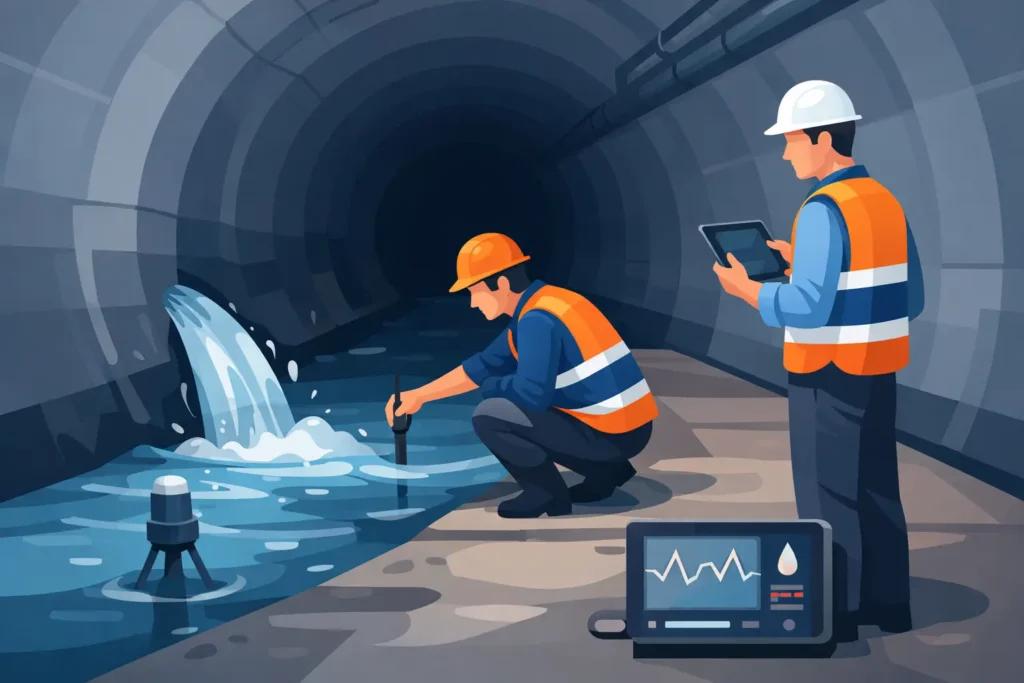
A tunnel rarely gives you a single clear warning about water. More often, the first sign is a damp patch that grows between rounds, a local drip becoming a steady run, or a sump pump that starts working harder than expected. That is why knowing how to check tunnel water inflow matters early, before the issue turns into instability, excessive grouting, programme delay, or a dispute about what was foreseeable.
For practising tunnel engineers, the question is not only how much water is entering. It is also where it is coming from, whether the inflow is transient or persistent, how it relates to the groundwater regime, and whether the observed values are compatible with the design assumptions. A useful check therefore combines measurement, geological interpretation, and a consistent way of recording change over time.
What you are actually trying to measure
Tunnel water inflow is often discussed as though it were one number. In reality, several different quantities may be relevant. You may need the total inflow to a tunnel section, the local inflow from a particular fracture zone, the inflow per metre of excavation, or the residual inflow after pre-grouting. Each tells a different part of the story.
This distinction matters because a low total inflow can still be problematic if it is concentrated in one faulted section, while a higher total inflow may be acceptable if it is diffuse and easily managed by drainage. The check should therefore be matched to the engineering decision in front of you. If you are deciding whether to continue excavation, localised inflow and face conditions may be decisive. If you are assessing environmental drawdown, cumulative tunnel inflow over distance and time is more relevant.
How to check tunnel water inflow in practice
The most reliable approach is to treat inflow control as a measurement system rather than a one-off observation. A bucket and stopwatch can still be useful for a single point discharge, but that alone is not enough for most projects.
Start by defining the control section. This could be a tunnel face, a five metre chainage interval, a mapped seepage zone, or a completed section between two plugs or bulkheads. If the section is not clearly defined, measured inflow values become difficult to compare from shift to shift.
Next, separate visible point inflows from general seepage. Point inflows can usually be measured directly by channelling water into a container or through a temporary weir arrangement. General seepage is harder. It may need to be estimated through drainage collection, pumping records, or by isolating a section and measuring what reaches the sump over a known period.
Timing also matters. Inflow immediately after blasting or scaling may differ significantly from inflow measured twelve hours later. Freshly opened fractures can drain rapidly at first and then reduce, while intersection with a connected water-bearing feature may show increasing inflow as the drainage path develops. If the project compares measured inflow against contractual limits or grouting criteria, the timing of the check must be agreed and repeated consistently.
Direct measurement methods
For localised flows, direct volumetric measurement remains the simplest and often the most defensible method. Water is collected from a specific point, discharged into a calibrated container, and measured against time. For modest flows, this gives a quick result with little equipment. The limitation is obvious – it only works where water can be captured reliably and where the flow is not mixed with debris or shotcrete wash.
Where inflow is channelled into drains or pipes, inline flow metres can provide a better continuous record. These are particularly useful when the objective is to see how inflow changes after probe drilling, pre-grouting, or excavation through a suspected weakness zone. The quality of the result depends on installation. Poorly filled pipes, turbulent flow, or sediment build-up can make readings less reliable than they appear.
At the larger scale, pump discharge records are often used as a proxy for tunnel inflow. This can work well if the pumping arrangement is simple and if other water sources are excluded. On many sites, they are not. Construction water, cleaning water, drill flushing water, and rainfall entering portals can all distort the picture. Pump records are valuable, but only if someone has checked what the pumps are actually handling.
Geological and hydrogeological context
A measured inflow rate without geological context is only half an engineering observation. The same inflow value means different things in massive low-permeability rock, in a fractured contact zone, or near a soil-rock interface under high hydraulic head.
Every inflow check should be read alongside engineering geological mapping. Note the rock type, fracture frequency, aperture, fillings, alteration, and any sign of structures that could transmit water over distance. Probe holes and percussion drilling records can be especially helpful, because sudden water losses or returns often indicate connected features ahead of the face.
Hydraulic head is equally important. A modest observed inflow may still indicate a significant pathway if the available head is low. Conversely, a strong discharge under high head may reduce sharply after pressure relief. This is one reason why inflow checks should not be interpreted in isolation from piezometric data where such data exist.
Checking inflow before and after grouting
One of the most common reasons to measure tunnel inflow is to judge the effect of pre-grouting or post-grouting. In that setting, consistency is more important than sophistication. If the before and after measurements are taken with different methods, at different times after excavation, or over different tunnel lengths, the comparison becomes weak.
A sound approach is to establish a baseline from probe hole observations, face mapping, and early inflow measurements, then repeat the same checks after grouting and excavation advance. Residual inflow should be assessed both locally and over the treated section as a whole. It is not unusual for grouting to reduce major point inflows while leaving low-level seepage largely unchanged. Whether that counts as success depends on the design criterion.
It is also worth remembering that reduced inflow is not the only performance indicator. Grout take, refusal behaviour, grout spread pattern, and changes in groundwater levels can all help explain why measured tunnel inflow did or did not change as expected.
Common errors when checking tunnel water inflow
The most frequent error is mixing different water sources. If inflow, flushing water, and cleaning water all end up in the same sump, the recorded volume tells you very little unless the non-geological sources are subtracted with reasonable accuracy.
A second error is over-reliance on isolated readings. Tunnel inflow is inherently variable. A single check may capture a temporary peak or a temporary lull. Trend data over rounds, chainages, and time periods are usually more useful than one apparently precise number.
A third issue is poor localisation. Saying that a tunnel section takes ten litres per minute is less useful than identifying that eight litres per minute come from one crown fracture between two mapped joints at a specific chainage. Localisation supports better grouting decisions, better support design, and better records if questions arise later.
There is also a tendency to assume that more data automatically means better understanding. It does not. What matters is whether the measurements are tied to a clear engineering purpose and recorded in a way that can be interpreted in detail.
How software improves the checking process
For many projects, the difficulty is not taking a measurement. It is keeping the measurements structured, comparable, and available across the design and production workflow. That is where simple to use software tools can make a practical difference.
If inflow observations, chainages, geological notes, grouting records, and calculated values sit in separate notebooks or spreadsheets, interpretation becomes slow and error-prone. A more disciplined digital workflow makes it easier to compare expected and measured inflow, review trends after each round, and present results clearly to the site team, designer, or client.
This is particularly useful when working across desktop and mobile devices. Tunnel observations are often made underground, while the technical assessment happens later in the office or during a coordination meeting. Software designed around straightforward, user-friendly input handling helps bridge that gap without turning routine engineering checks into an administrative exercise. For firms working on Apple devices, that continuity is still unusual enough to matter.
What a good inflow check looks like
A good check is proportionate. It uses direct measurement where possible, records the location and timing clearly, separates water sources, and relates the result to geology and hydraulic conditions. It also accepts uncertainty. There will be cases where the best answer is not one exact inflow value, but a credible range together with a clear explanation of why it varies.
That is often the difference between a useful engineering record and a number that looks tidy on paper but does not survive scrutiny. Tunnel water is rarely neat. The checking method should be disciplined enough to capture reality, but simple enough to be repeated reliably by the people doing the work.
If you set up the process well, inflow checking stops being a reactive task and becomes part of how you steer excavation, grouting, environmental control, and technical judgement from one round to the next.