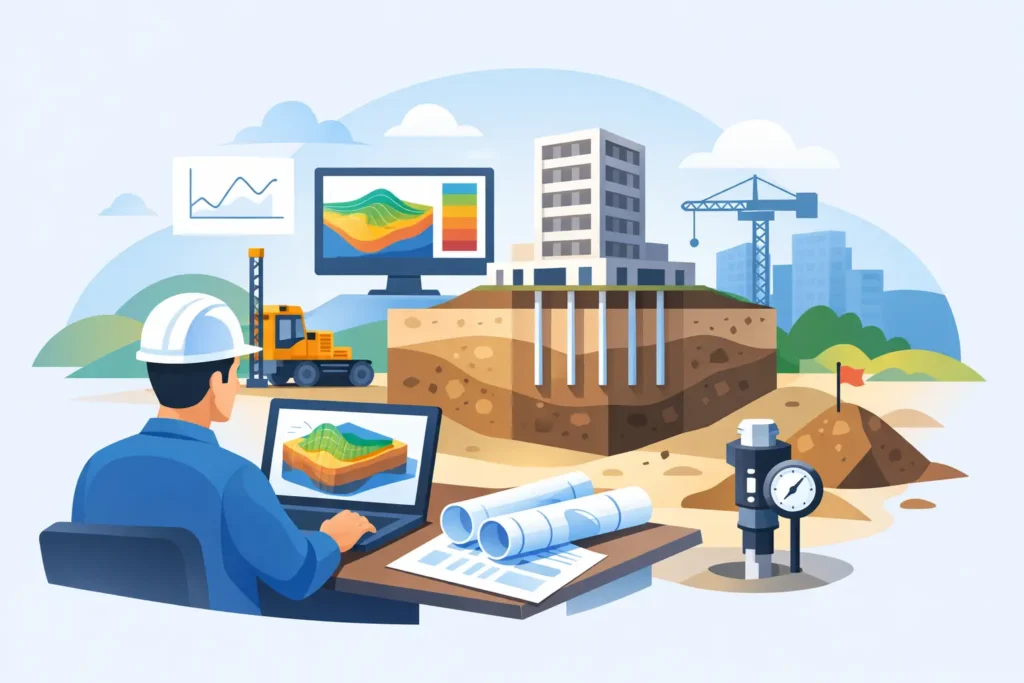
A slope assessment rarely fails because an engineer forgot the theory. More often, time is lost in setting up the problem, re-entering data in different tools, checking whether units have carried through properly, and explaining results from software that was never designed for the way geotechnical work is actually done. That is where geotechnical software either earns its place or gets in the way.
For practising engineers, software is not an abstract productivity layer. It is part of the technical method. It shapes how quickly a model can be built, how clearly assumptions are recorded, and how confidently results can be reviewed before they leave the desk and become part of a design note, a claim analysis, or a site decision. Good software supports engineering judgement. Poor software consumes it.
What geotechnical software should really do
In geotechnics, calculations are rarely valuable in isolation. A bearing capacity check, a seepage estimate, a grouting calculation, or a tunnel-related assessment only matters when the input assumptions are transparent and the output can be interpreted without unnecessary friction. That sounds obvious, yet many tools still prioritise feature count over actual working practice.
Useful geotechnical software should first make problem setup straightforward. If the engineer spends too long navigating menus, building workarounds, or hunting through settings that have little to do with the task at hand, the software is already adding risk. Straightforward input handling matters because most errors begin there. A clear structure for soil parameters, geometry, loads, groundwater conditions, and construction assumptions is not a cosmetic detail. It is part of quality control.
The second requirement is calculation reliability. This goes beyond whether an equation has been implemented correctly. Engineers need confidence that the software behaves predictably across normal use cases, edge cases, and revision cycles. If a parameter change produces an unexpected jump in output, the reason should be traceable. If a method has limits, those limits should be clear.
The third requirement is result presentation. Geotechnical work often involves communicating with colleagues from other disciplines, clients, contractors, and review engineers. Graphical output is helpful, but only if it supports interpretation rather than decoration. Text-based output remains equally important because engineers need to follow calculations in detail, check assumptions, and document the basis of decisions.
Why generic engineering platforms often fall short
There is a persistent assumption that bigger software platforms are automatically better. In practice, it depends on the task. Large multipurpose systems can be useful for organisations that need one environment for many disciplines, but ground engineering problems are often too specific for a generic approach to feel efficient.
Geotechnical analysis is full of practical nuance. Soil and rock parameters are uncertain. Construction sequence matters. Groundwater can dominate the behaviour of a problem that otherwise looks simple on paper. Grouting and tunnelling work, in particular, often demand tools that reflect field realities rather than idealised textbook conditions.
When software is built without that context, the engineer ends up compensating. Inputs may need to be forced into structures that do not fit the problem. Outputs may be technically correct but awkward to explain. The package may contain hundreds of functions, yet still make a common daily task slower than it should be.
That is why specialist tools continue to matter. A narrower application can often deliver better engineering value if it is designed around the decisions users actually need to make.
Geotechnical software on Apple devices
For engineers who work on macOS, iPhone, and iPad, the problem is even more specific. Serious geotechnical software has historically been concentrated on other platforms, which has left many Apple-based professionals with fragmented workflows. They may calculate on one machine, annotate elsewhere, and carry static exports to site meetings because the working tool is not available on the device they have with them.
This is not just a convenience issue. It affects continuity of technical work. If software behaves consistently across desktop and mobile devices, an engineer can review inputs, revisit assumptions, and discuss results in a meeting without breaking the calculation chain. That can be particularly useful in tunnelling, infrastructure, and geotechnical consulting, where decisions often move between office review and field discussion.
There are trade-offs, of course. Not every large-scale analysis task belongs on a phone or tablet, and no experienced engineer would claim otherwise. Complex modelling, extended interpretation, and formal reporting are still best handled in a full desktop environment. But mobile access becomes valuable when it is treated as part of the same workflow, not as a stripped-down afterthought.
This is where Apple-focused specialist development has a clear place. Psicons AB, for example, has built software specifically for geotechnical and tunnelling professionals who want technically serious tools on the Apple ecosystem. That matters because software designed from the start for macOS and iOS tends to feel more coherent than software merely adapted to those platforms later.
What engineers should look for in geotechnical software
The first thing to assess is whether the software reflects real engineering tasks. That means asking a simple question: does the workflow match how the problem is defined in practice? If the answer is no, more features will not rescue it.
Input handling deserves close attention. Engineers should be able to enter data in a structured, readable way and revise it without losing track of what changed. In many projects, the calculation itself is not the slow part. Iteration is. Ground conditions are updated, geometry changes, design stages move forward, and assumptions are refined after discussion with the wider team. Software that supports quick, traceable iteration saves time where it actually matters.
Method transparency is equally important. Specialist users do not want a black box, particularly in geotechnics where judgement remains central. The software should make clear what method is being used, how parameters affect the result, and where the engineering limits are. That is true whether the task is slope stability, settlement-related work, grouting assessment, or tunnel analysis.
Usability also matters more than some firms admit. There is sometimes a tendency to confuse complexity with seriousness. In reality, difficult software is often just inefficient software. A simple user interface can still support advanced technical work if it is built by people who understand the domain. In fact, that is usually when simplicity is most valuable.
Accuracy is necessary, but not sufficient
Engineers rightly focus on accuracy, yet software selection often fails because accuracy is treated as the only criterion. If two tools produce comparable numerical outputs, the practical choice may come down to how well the software supports checking, interpretation, and communication.
This is especially relevant in projects involving review cycles, contractor discussions, or claim-related analysis. A result is only useful if the underlying assumptions can be explained and defended. Software that produces clear graphical and text outputs gives the engineer a better basis for discussion. That does not make the analysis less technical. It makes the technical work easier to follow.
There is also a professional benefit in using tools that stay close to engineering language. Many practitioners do not need elaborate digital environments with layers of project administration wrapped around every calculation. They need reliable software tools that let them define a problem, calculate it properly, and inspect the result in detail.
The case for specialised, simpler tools
A great deal of software procurement still happens at organisational level, where decisions are influenced by standardisation, licence structure, and broad compatibility. Those considerations are real. But from an engineering perspective, there is a strong case for smaller, specialised tools that solve specific problems well.
In geotechnical work, simpler does not mean simplistic. It means the tool has been disciplined. It includes what supports the calculation and leaves out what distracts from it. That can lead to faster setup, fewer input mistakes, and better concentration on the engineering itself.
This approach tends to suit experienced users particularly well. Practitioners with field and design background are often less interested in software spectacle than in dependable behaviour. They want tools that are easy to follow in detail and straightforward to use under project pressure.
That is also why founder-led specialist software companies often produce credible tools in technical niches. When development is informed by direct experience in soil mechanics, rock mechanics, grouting, and underground construction, design choices are less likely to be theoretical. They tend to reflect what engineers actually need on a live job.
Choosing geotechnical software is therefore not just a software decision. It is a decision about how engineering work will be carried out, checked, and communicated. The best tools are not the loudest or the largest. They are the ones that help competent engineers work clearly, efficiently, and with proper control over the details that matter.